

Linda Rotua Sormin, Uncertain Ground curated by Sequoia Miller, Gardiners Museum, Toronto, November 2025-April 12th, 2026.
Written by: Ella Bigras


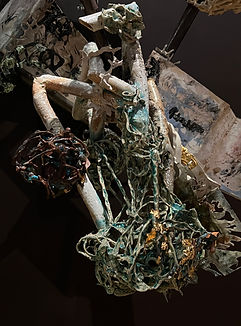
Behind closed doors on the freshly renovated third floor of the Gardiner museum lies the other worldly experience of Uncertain Ground. Onlookers would be surprised to hear that this is Sormin’s first solo show. Thoughtfully curated by Gardiners chief curator, Sequoia Miller, the show introduces viewers to Batak mythologies. Sormin–having ancestral ties to the Batak peoples of North Sumatra Indonesia and family histories in China and Thailand–uses the exhibition to explore her own diasporic experience that has shaped her and her artistic practice. The exhibition works together on three levels to convey Sormin’s story. The central locus signifies lake Toba (a volcanic lake present in Batak mythology) and evokes mythical beasts. The surrounding area and walls are representative of the current, human occupied world; the accompanying film references an imagined celestial realm. This bold choice proves effective in the exhibition space–orchestrating a dialect between the three realms. The layered approach to the exhibition pays homage to the way Sormin’s layered identity informs her work. Through multi-media installation, film, and an accompanying poetry book, Sormin creates a hermetically sealed fantastical world; Offering intense insight into the complexities of identity.
The exhibition's intimate and daunting affect foregrounds the sense of looking into a physical manifestation of the psyche. Mutli-sensory tactics used in the exhibitory space work together to create an all-consuming affect. As viewers arrive at the exhibition door they are invited to wave at a motion sensor, the door automatically opens: from this moment onward control is surrendered to Uncertain Ground. The exhibition envelops the viewer. Dim lighting fills the room, as the film produces a techno-static hum and flashes of bright colours. The central installation piece forms a large ramp, guiding viewers through a forest of complex ceramic lattices. Web-like ceramic vessels jump out from the walls, and the overall structure of the exhibition angles in. The concave film screen and wall installation pieces encroach upon the viewer’s space and add to the overwhelming affect. An ominous feeling looms throughout the room as a screeching static sound and muffled voices emanate from the film. The multi-sensory approach works together in order for the viewer to abandon control and become fully submerged in the exhibition. Providing a stable setting for the analogy offered, where metaphorical neural pathways act as a vehicle for identity exploration.
Materials have a voice and tell their own unspoken story within a work. Large web-like rhizomatic sculptures take over the exhibition. Intricate ceramic vessels held up by two by four’s and steel bars (reused from Gardiner’s recent renovation project) jut out from the walls, weave through the central installation piece, and line the floor. Each piece is completely unique. Some finished with glazes in rich turquoise’s, others raw terracotta dripping with powder blue and celery green glaze. And some composed of raw clay: unfired, waiting to be reclaimed and reformed. Sormin comments on the sporadic outcome of her glazing technique in a video interview for the Gardiner museum. The materiality of the ceramics allows for unique frictions
and textures that “could only come through in glazes that were melting too much, or colours that were seeping and bleeding into other colours...the drama that can play out through the phenomenon of ceramics has been the way that I've been conveying some of the feelings I have about my ancestral histories” (Sormin 2025). Sormin’s process proves to be intuitive, and the outcome becomes an embodied experience where the external signifies the internal. The materials of the installation are charged with the artist's internal sentiment.
The environmental crisis undeniably influences and has changed artistic practices, where artists are rethinking ways in which to create sustainably. In the ‘human realm’ layer of Uncertain Ground Sormin grapples with what it means to exist here and now in the age of technology, AI, digital fabrication, and environmental collapse. Interlaced throughout the installation are traces of human waste. Offcuts from laser-cut acrylic, discarded supports from 3D printed projects, and bits of waste are haphazardly stuck to the outside of the sculptures, or caught within the ceramic lattice’s. Here, Sormin calls attention to the materials of making, and the repercussions. Questioning and providing solutions to ways in which a sustainable art practice can be nurtured. And ultimately showcasing that environmental crisis affects every individual. If the exhibition proves to be a representation of the human psyche, then the waste and plastics embedded within the metaphorical psyche showcases how deeply the individual is intertwined with the repercussions of their waste. The nod to sustainability is essential to the show, reflecting on what it means to exist and create within the chaos of the environmental crisis.
What does it mean to be alive and assert autonomy? The web-like vessels resemble quasi- neurons. Therefore, the eclectic makeup of Sormin’s sculptures provides commentary on the complex structures that make up an individual's psyche. Symbols and hidden elements scatter the exhibition–waiting to be found. Elements such as pushtas (accordion folded divination from Batak culture), animals such as lambs or bears, and a multitude of found figurines, are scattered throughout the installation. Either encapsulated by complex ceramic webs or laying discarded in areas of debris on the ground. For Sormin these items are paraphernalia of the diasporic experience. These gestures physically show how fragmented pieces of one's identity embed and entangle themselves within the internal structures of an individual's being. This fragmentation is also present within the energy of the work. The varied nature of the structure makes it feel like a living organism, changing and growing. Each visit unveils something that went unnoticed before. Fluttering gold leaf and tiny found sculptures reveal themselves the more time spent in the exhibition almost mimicking the very nature of memory, and highlighting the fragmented nature of memory and identity. Uncertain Ground acts as a living organism pulsating with memories.
Uncertain Ground arrives at the intersection of identity and what it means to exist in the modern day. Sormin’s dimensional, sensorial approach proves effective, innovative, and nuanced. The viewer becomes fully immersed and enters a place of exploration within the exhibition's closed walls. The layered structure of the exhibition mixed with the aesthetic structure of Sormin's ceramic vessels, work in tandem to serve as a metaphorical structure of the human psyche. Physically representing the complex makeup, and unknown, eclectic nature of what creates one's personhood. Exploring how identity, lived experience, and family histories influence and persist. The exhibition begs questions of what it means to connect and express the complexity of one’s identity. Ultimately, the human psyche proves to be formidable, complex, ever-changing, and interconnected.
Works cited
Sormin, Linda Rotua “A Sky Not Meant to Be Read.” Vimeo, 2025. vimeo.com/1139743941?autoplay=1&muted=1&stream_id=Y2xpcHN8MTQ1ODk3NX xpZDpkZXNjfFtd.
Sormin, Linda Rotua, “Linda Sormin.” 2025. www.lindasormin.com/.
“Linda Rotua Sormin: Uncertain Ground.” Gardiner Museum, 2025. www.gardinermuseum.on.ca/event/linda-rotua-sormin-uncertain-ground/.